
Contents of fish feed 2025
Below in this text is the data for raw material composition of fish feed.
Responsible sourcing and use of feed ingredients is core of our business.
Aquaculture feed can contain many different ingredients of vegetable, marine and land animal origin. The most common agricultural crops are soy, wheat and rapeseed. Marine ingredients traditionally originate from wild fisheries like sardine, anchovy, herring and many more. There are a number of sustainability issues linked to the primary production of feed ingredients. Cultivation of agricultural crops needs to be responsible; otherwise, it can lead to detrimental impacts like deforestation, loss of valuable habitats (for example rainforests and wetlands), excess use of water and soil erosion – to mention a few.
A wild-capture fishery needs to be responsibly managed so that it is not overfished and does not lead to the unwanted catch of protected or endangered species.
The primary source of the feed ingredient is processed into different forms; wheat can be processed into wheat flour and wheat gluten, soy into soybean meal, soybean concentrate and soybean oil. A fish or by-products from fish can be processed into fish meal and fish oil. This means that the primary sources of the feed ingredients are shipped to a factory and processed into the feed ingredient by manufacturers of feed ingredients.
There are a number of sustainability issues that are common for manufacturers. For instance, the manufacturing process must not lead to environmental pollution like harmful emissions to air or effluents to water. Sustainability also encompasses social issues, including ensuring that the factory is a safe working place. In addition, manufacturers must respect basic human rights and labor rights.
Skretting operates a system of systematic evaluation of the sustainability risks linked to primary sources of feed ingredients and manufacturers of feed ingredients. Based on the outcome of these risk assessments, the combination of primary source and manufacturer of feed ingredient must be evaluated and approved before a Skretting company can buy the feed ingredient.
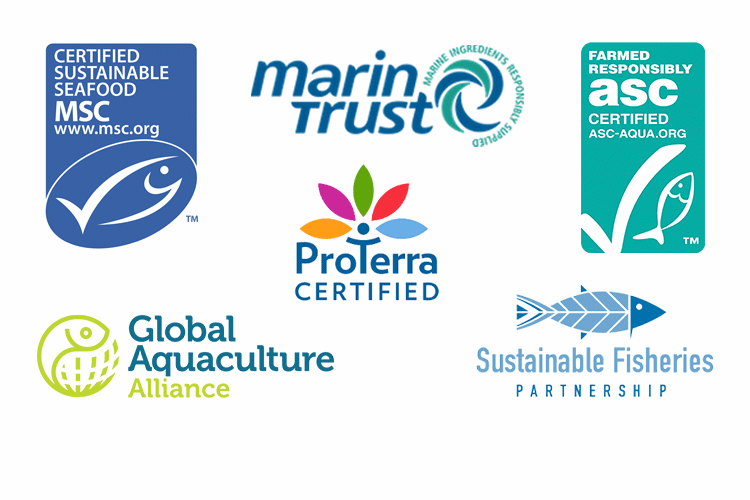
Skretting Norway is also certified under ASC's new feed standard, Aquaculture Stewardship Council (ASC) Feed Standard 1.01, which requires comprehensive documentation confirming that the ingredients come from socially responsible suppliers and producers, and that the raw materials are environmentally friendly.
(Click here for more information about Skretting's ASC certification).
Our Supplier Code of Conduct enables us to engage with our suppliers on material issues relating to their operations and to set minimum criteria relating to environmental, social and legal aspects.
Average raw material composition of 1 kg of fish feed
| 2025 | 2024 | 2023 | 2022 | 2021 | |
| MARINE PROTEIN | |||||
| Fish meal from whole fish | 8.7% | 10.2 % | 12.0 % | 11.1 % | 10.4 % |
| Fish meal from trimmings | 2.6% | 3.4 % | 3.2 % | 5.4 % | 2.7 % |
| VEGETABLE PROTEIN | |||||
| Soy protein concentrate | 15.2% | 16.6 % | 15.0 % | 11.5 % | 13.5 % |
| Faba beans | 5.1% | 5.4 % | 6.5 % | 6.8 % | 4.8 % |
| Wheat gluten | 11.5% | 10.0 % | 8.0 % | 10.3 % | 10.2 % |
| Sunflower meal | 5.2% | 4.5 % | 4.5 % | 7.3 % | 6.0 % |
| Pea protein | <0.1% | 1.0 % | 0.8 % | 0.0 % | 0.7 % |
| Guar meal | 8.9% | 7.1 % | 8.3 % | 5.7 % | 7.9 % |
| NOVEL PROTEINS | |||||
| Insect meal | 0.02% | 0.01% | 0.00% | 0.00% | 0.02% |
| Krill meal | 0.20% | 0.19% | 0.30% | 0.02% | 0.02% |
| Calanus | <0.01% | 0.01% | 0.01% | 0.00% | 0.00% |
| Crab meal | 0.12% | 0.02% | 0.03% | 0.06% | - |
| NOVEL OILS | |||||
| Micro algea oil | 0.68% | 0.60% | 0.63% | 0.53% | 0.20% |
| MARINE OILS | |||||
| Fish oil from whole fish | 5.7% | 4.7 % | 7.0 % | 6.7 % | 7.0 % |
| Fish oil from trimmings | 3.0% | 5.2 % | 3.5 % | 4.3 % | 3.2 % |
| Fish oil from farmed fish* | 1.5% | 1.1 % | 0.8 % | 0.9 % | 1.0 % |
| VEGETABLE OILS | |||||
| Rapeseed oil | 17.8% | 16.6 % | 15.1 % | 17.0 % | 18.8 % |
| Camelina oil | 0.2% | 0.3 % | 1.1 % | 0.5 % | 0.8 % |
| Linseed oil | 2.3% | 1.9 % | 2.8 % | 1.0 % | 0.6 % |
| CARBOHYDRATES | |||||
| Wheat | 7.7% | 7.9 % | 7.0 % | 6.9 % | 7.9 % |
| OTHER | |||||
| Micro ingredients | 3.7% | 3.4 % | 3.4 % | 3.9 % | 4.2 % |
| SUM | 100% | 100 % | 100 % | 100 % | 100% |
* Fish oil from farmed fish (salmonids) is only included in customer specific feeds. For more information about food safety, scientific studies and experience with salmon oil, click here.
Origin of novel raw materials 2025
| Country of origin and cultivation/ harvest | |
| Insect meal | France |
| Krill meal | Antartica |
| Calanus | Norway |
| Crab meal | Norway |
| Micro algea oil | USA, Brazil, China |
For origin of marine and vegetable raw materials see the pages for marine and vegetable details.